Showing posts with label Kelantan. Show all posts

Tuesday, October 31, 2023

Types of Kelantan's Nasi Kerabu

Kelantan, birth place of the famous Nasi Kerabu - a blue-colored rice set that comes with ulam (local salad), crackers, percik chicken, fried fish, smoked beef, solok lada (stuffed peppers) and salted egg. This is top with homemade chili sauce, budu sauce (pickled anchovies sauce) and tumis (stir-fry chili paste) for gravy. 


It is said that Nasi Kerabu originated from Pattani during the Sultanate of Patani reign, now the modern Thailand provinces ie Pattani, Yala, Narathiwat as well as part of the modern-day Kelantan, Malaysia. It was during this reign, under successor Raja Kuning (The Yellow Queen) was at war with Singgora (modern-day Songkhla) when Pattani armies were having food shortage that lead to the military cook ration and invent Nasi Kerabu. Nasi Kerabu then was rice mixed with budu and serunding (grated coconut) and ulam. 

Many might not known that there are few types of nasi kerabu such as Nasi Kerabu Bunga Telang/Biru , Nasi Kerabu Kunyit/Kuning, Nasi Kerabu Putih, Nasi Kerabu Hijau/Ulam and Nasi Kerabu Hitam/Daun Mengkudu. There's is also Nasi Kerabu Tumis whereby the tumis is being added and usually onto Nasi Kerabu Putih and Nasi Kerabu Kuning/Kunyit. Nasi Kerabu has evolved to what it is today. 


Photo credit : Google

Nasi Kerabu Bunga Telang/Blue
The blue colour of the rice came from comes from the petals of bunga telang, what us locals call or butterfly-pea flowers. It is a natural food colouring used by our forefathers.


Nasi Kerabu Kuning/Yellow Kerabu Rice
Apparently Nasi Kerabu Kuning or Kunyit is not easily found in Kelantan, some said that it is common in Bachok area. Nasi Kerabu Kuning's rice is cooked with tumeric (hence the colour) and some even added pandan leave. Because of this 2 key ingredient, the rice is more aromatic and tasted nicer. The dishes and sauce are the same as Nasi Kerabu Bunga Telang with exception of the Tumis.


Nasi Kerabu Putih/White
This is the easiest to make as it uses the normal white rice with Tumis as the differentiator, salad and budu is a must for Nasi Kerabu.


Nasi Kerabu Hijau/Green (Peranakan Cina Kelantan)
Nasi Kerabu Hijau is rare as it is part of the Peranakan Cina Kelantan delicacy, and it is available at Popo Kitchen 1.0 in Kota Bharu. What makes this Nasi Kerabu unique is that it is made with 23 types of herba (herbs) and ulam blended and cook it with the rice. And that is not it, out of this 23 types of ulam, 10 of it is from the jungle. It is served with juicy ayam percik together with ulam such as bunga kantan (wild ginger), tauge (beansprout), kobis merah (purple cabbage), timun (cucumber) and kacang panjang (long bean), and of course Kelantan signature budu.


Nasi Kerabu Hitam/Black 
The rice is made by cooking it with daun mengkudu (indian mulberry leaf) and kaffir lime leaf - most rare type of Nasi Kerabu. The side dishes and sauce are again similar just that the taste of the rice is more herb-ish and the kaffir lime leaf creates the nice frangrant.

To be honest, Nasi Kerabu Hitam is the only one that I have yet to sample. If you know where I can get this, please ping as I plan to revisit Kelantan very very soon. 


#JejakWarisanBachok and #JejakAdiguru 2023 Media Fam Trip is organized by Tourism Malaysia Wilayah Timur in partnership with all its sponsors.
#TourismMalaysiaWilayahTimur #CutiCutiMalaysia


Monday, October 23, 2023

Preserving Kelantan's atap Singgora/Singhora (roof tiles) heritage

Noted as Kelantan's preserved traditional heritage, Singgora is a clay roof tiles that is being produced using purely manual labour. This roof were and are still being used in some traditional homes, palaces and resort with traditional architecture. The roof originates from Thailand and now has become part of the Malay traditional architecture. What makes it unique is that the soil being used is only available in Bachok as sodium content in the soil is a prerequisite in making a good Singgora roof tiles (tanah bendang air masin to be specific). The whole process of a roof takes an estimation of 2 months for it to be ready and send to the customer.


Preserving this heritage is Puan Noraini Jusoh, the fifth-generation of singgora tile makers family, learning the art of tiles making from her father.

The origin - Sultanate of Singora
Previously known as the Malay-Muslim kingdom of Sultanate of Singora is now called Songkhla, located in the southern Thailand and was founded in the 17th century. It is known that there is a slight difference between the Thai Singgora tiles versus ours, having said that the characteristic remains the same - it being light and porous thus enabling it to absorb water (rain) easier acting as a cooling system in a home. Due to its thin and light in size makes it esier to break which is its drawbacks


In order to strengthen the roof tile, grog is added during the clay process. Grog is a pre-fired clay taken from rejected post-firing Singgora clay sheet. It is crushed and later sieves to sand-like texture, the grog is then mix with the clay and ready for the first step - wedging and kneading. 

Click here to view a 1 min video on the making of atap Singgora/Singhora roof tiles.

Wedging and kneading (menguli dan memijak)
This task is usually done by men due to it being strenuous - wedging and kneading for 3 rounds at least as this is to ensure that the air are not trapped inside the clay making it to crack or break with ease.

Moulding (acuan)
Once the clay is well kneaded, it is then places into a mould where the men uses his leg to press to form the shape. 

Drying (kering)
The shaped clay is placed under the sun for about 2 days to dry.

Firing and kilns (bakar dan tanur/gok)
The dried clay is put into a traditional kiln called the Dragon Kiln and is being fired for 10 days. The kiln here is still using the old method ie wood and is fired at 800c in temperature. 

Ready Singgora roof tiles are sent to the customers after the 2 months process.


#JejakWarisanBachok and #JejakAdiguru 2023 Media Fam Trip is organized by Tourism Malaysia Wilayah Timur in partnership with all its sponsors.
#TourismMalaysiaWilayahTimur #CutiCutiMalaysia


Thursday, October 19, 2023

Kelantan's Perahu Kolek - A Malay culture and heritage

First time hearing about perahu kolek or kolae boat was in Terrapuri, a story shared by Mr. Alex - man of vast knowledge on Malay culture and heritage. And again I heard about this beautifully crafted (and painted) boat is from Mawardi of Projek Travel - a guy that never fail to surprise me with his videos and historical information (my partner in crime on culture content, so I myself claimed).


Those that know me, knows me well and those in this trip (mostly new friends) were making fun of my 'angkat tangan-saya ada soalan' way of getting information. A habit (good, I hope) that I don't plan to 'unhabit' real soon, so kawan-kawan ku disana - suck it up kay! Hahahhaha... (Eh! THis entry was supposed to be article-ish tapi tetiba jadi lawak pulak [facepalm], oh well [eyes rolling]).

Motif
This vividly coloured kolae boat originated from southen part of Thailand and are used by the Malay communities there. A craft that is uniquely 'belongs to the Langkasuka Kingdom' territories, has established it presence in Malaysia east coast states namely Terrenganu and Kelantan. Usually measures approximately 12.5 metres in length is built from Malaysia local tree ie Merbau, Meranti and Cengal and is split into 4 sections namely Bangau, Penyendal, Buluh and Okok. The decoration/motifs are influenced by Thai and Malay style as one can easily see flora and fauna motifs such as lotus, sea serpents, dragon, bird, floral and etc on its Bangau.


Makara
As perahu kolek is used during the Langkasuka Kingdom period, makara is often carved and painted on the bangau and tail of the boat. Makara is a type of sea animal used by the God Vishnu during his travel at sea. Back then, they believe that the makara or animal motifs are able to communicate with the wild sea and will safeguard the them/fishermen from evil spirits of the sea.

Offering
I was made to understand that during those days, offering tradition is actively practised where the offerings are put onto banana leaves depicting a boat shape. This 'boat' is later being floated into the sea as an offering to the spirit of the sea. 

Superstitious
Perahu kolek is a tool for the fishermen to earn a living hence it is treated with the highest respect. It comes as no surprise that some are still superstitious when it comes to stepping into the kolae - shoes are not allowed inside the boat, running too was not allowed near the bangau section, urination and defecation should not take place near the bow and profanity is a no-no. 


Doa
Muslim has taken the lead in Malaysia hence reciting dua - seeking protection from Allah is being practised heavily now.

Where can you experience Perahu Kolek 
You can check out Perahu Kolek as well as the floating market at Pengkalan Datu - Cerana Villa Resort.


#JejakWarisanBachok and #JejakAdiguru 2023 Media Fam Trip is organized by Tourism Malaysia Wilayah Timur in partnership with all its sponsors.
#TourismMalaysiaWilayahTimur #CutiCutiMalaysia


Tuesday, April 26, 2022

Kelantan's Islamic Museum

I confused myself.
The one in KL that most of us visited was the Islamic Arts Museum Malaysia, located on Jalan Lembah, Tasik Perdana where else the one I went to recently in Kelantan was the Kelantan Islamic Museum that is situated in Kota Bharu (KB). I was overwhelmed, and highly encourage you guys to drop by at this place if you are ever in KB.

Before I even start sharing about the museum, I have to say that the building itself was amazing. For those who love architecture or old buildings, this is one of the nice few in KB. It seems that the architecture is a blend of Nusantara and colonial touch. This double story bungalow was built by wood and embedded with Islamic calligraphy of verses from the Quran, it was later renovated, and bricks and cement were used.


One might not know (or already know) that Kelantan is also coined as ‘Serambi Mekah’ or ‘Verandah to Mecca’ as it being the hub of Islamic Education hundreds of years ago. Its traditional education ie ‘sekolah pondok’ or ‘pondok studies’ flourished in early 19th century and still in existence till this present day, I have also written about it HERE.

Kelantan Islamic Museum is also known as Syura Hall or Balai Syura, was built back in 1902 as a residence for the Chief Minister of Kelantan, who served from 1900-1920.
 
Its intricate Kelantanese carving of the wall panels in known as Janda Berhias, a motif that was popular on the Peninsular Malaysia East Coast. Bumbung Limas Bungkus is the other character of the house roof which is a multi-tiered pyramid structure and it is covered with clay roof tiles called Genting Singgora – originated and named after the province of southern Thailand.
 
When I wrote this, I tried to find a site that state how the museum is being segmentised but to no avail, hence I am gonna break-it down to the best of my knowledge and gutfeel.
 
Kampung Laut Mosque

Known to be the oldest mosque in Malaysia, this 300 years mosque was originally located in Kampung Laut in Tumpat and later was moved to Nilam Puri due to recurring flood. To ensure its safety and that the architecture being preserved, the authority feels the need to move it. Unlike many modern mosque that is highly influenced by middle eastern or moor architecture, the Kampung Laut Mosque characteristic is of Nusantara style where the floor plan is square in shape that reflected on its roof as well - a three-tiered Meru roof (pyramidal roof). The museum shared information of this old mosque invaluable architecture, its carving, the mimbar, its gong (used to call for prayers) as well as belindan plank (kancapuri); a grave boundary used at the tombs of the Malay Kings and noblemen.
 
Textile of the Muslim

Showcased beautiful textiles worn by Muslim that were exported worldwide. Beauty and cleanliness is highly emphasize in Islam, it is being reflected in clothes, vail, handkerchief as well as household décor such as curtains, table cloth, tray cover and etc. Usually the motifs are of floral and cosmos.
 
Kelantan Religious Scholar

Highlighting the likes of Tok Kenali, Tok Bachok, Tok Selehor, Tok Padang Jelapang and many more. One that was stressed upon was Tok Kenali, he is the ‘father of Islamic education’. A Malay theologian and teacher that became the archetype of the rural Malay religious teacher (alim), he developed the Arabic-language instruction, help shape the state Majlis Agama Islam or Islamic Religious Council to oversee all aspects of Islam in Kelantan. This later became the model for the other Malay states.
 
Cheng Ho Treasure Ship

"Chinese treasure ships" (宝船; Bǎo Chuán), used by the commander of the fleet and his deputies, nine-masted, about 127 metres (417 feet) long, 52 metres (171 feet) wide, with four decks.
To put into perspective, some asked ‘Whose ship was bigger Columbus or Cheng Ho?
Zheng He's nine-masted flagship measured about 400 feet long; for comparison, Christopher Columbus's Santa Maria measured just 85 feet.
 
Cheng Ho is born in a Muslim family and adopted the surname Zheng conferred by the Yongle Emperor. History said that Cheng Ho was the great-great-great-grandson of Sayyid Ajjal Shams al-Din Omar, he served Mongol Empire administration and was also the governor of Yunnan during the early Yuan dynasty.
 
Firaun

Stated the story on how Nabi Musa A.S or Prophet Moses led his people cross the Red Sea. It is when Firaun/Pharaoh and his army approaching the Red Sea and about to take the very same path that Nabi Musa A.S took, the people and Nabi Musa A.S pleaded to Allah and ask Allah to close the sea. However, Allah commanded Moses not to smite the sea with his staff again, for Allah's decree was already in action. When the Pharaoh and his army were midway, Allah commanded the sea to return to its former state. The waters closed over him, drowning him and his entire army. Read HERE for the whole story


Other interesting section that you should look out for are the :
- Ottoman Soldier’s Battle Dress
- Flight Machinery by  Abas Ibn Firna


- Astronomy Quadrants by Taqi Ad-Din
- Dardanelles Cannon by Munir Ali
- Astrolabe by Umar Ibn Yusuf


- Pinhole Camera by Al-Haitham
- Mongul Illuminated Illustrated Manuscript

 
Kelantan Islamic Museum
Jalan Sultan
Kota Bharu
Kelantan

Operating Hours
Saturday - Thursday : 8.30am to 4.45pm
Closed on Friday

Entrance Fee
Adult : RM2.00 (Local), RM4.00 (Foreigner)
Kids :RM1.00 (Local), RM2.00 (Foreigner)

Contact
Kelantan Islamic Museum : +609-7482266
Kota Bharu Tourist Information Centre : +609-7485534


The Ihya’ Ramadan Kelantan 2022 Media Fam Trip is organized by Tourism Malaysia Wilayah Timur in partnership with all its sponsors.


Thursday, April 21, 2022

Kelantan Colek at Grand Renai (Kayangan-like presentation)


I mean… the word colek depicts how the food experience be like. So it doesn’t come with great surprise when I enquired further, I remember vividly how they describe the food ‘there’s fruit, there’s chicken and there’s sauce’. And my reply was ‘PASEMBOR!?!’ and the respond was…. ‘errr…. Similar but not the same’. A huge questions seems to dance on my head, a ‘ni apa?’ moment struck.

So I decided to check-it out and hopefully I love it lah (what is there not to love, it is food after all kan). Yet again, another surprise (‘surprise’ seems to be this trip middle name huh), instead of taking us to experience the usual-by-the-road-side-eating-while-eating colek, we were treated to a colek ‘kayangan’ which is available during this Ramadan month only.


What is ‘colek kayangan’ you may ask?
- ‘Colek’ basically means ‘to dab’ or in this case ‘to dip’ food in a sauce.
- And ‘kayangan’ literally means abode of the gods, or in local slang means super reach people.
Hence, colek kayangan means ‘dip food meant for the super reach people’, literally.
Can you see where this is heading?

Back to our story, we were brought to the Grand Renai Hotel in Kota Bharu to sample the colek, in a more comfortable environment and with such a hectic schedule, I totally welcome this. And guess what guys, when we were presented with colek… it was so cantik (pretty). Kid you not, this versus the one authentic version – memang banyak beza lah in terms of presentation.


We were presented with 3 tier ie 3 different types of colek, we had the fried stuff – chicken meat, gizzard, cucur and fried spring roll with sauce, rojak buah and fried lekor with sauce. Each food/fruit with its own respective sauce, and I have to admit, the rosak sauce is super sedap. I also absolutely love the mini fried popiah.

Rojak : Sliced fruit and vegetable salad served with a spicy palm sugar sauce.

My take on this.
It is definitely creative and I applaud. It might not be suitable if you want to lepak alfresco dining BUT if you plan to have dinner with client or a chat after a long meeting, then this will fit the bill (the presentation looks professional too). Perhaps if you want to impress you future in-laws where presentation is key then this is the right place. In fact, I would make a special request for this to be my tea-break food for CxO event – it’ll be perfect.


Grand Renai Rooms

I did a room tour while I was here, and I realized that the rooms here is super huge and suitable for family of 3 or 4 as you can add bed and it will still be comfortable. And the twin sharing room’s bed are 2 queen size beds, luxury huh! For those saying it’s an old hotel, I will agree with you but I have to add that it is well maintained and has recently been refurbished.


Grand Renai
Jalan Sultan Yahya Petra
Kota Sri Mutiara
Kota Bharu, Kelantan


The Ihya’ Ramadan Kelantan 2022 Media Fam Trip is organized by Tourism Malaysia Wilayah Timur in partnership with all its sponsors.


Monday, April 18, 2022

Kelantan Mosque Trail – Part 1

I already know what I am gonna blog!
MOSQUE TRAIL!

Ideally the mosque is close to each other lah, even better if it is walkable but itssokay as the mosque we visited are so unique and beautiful makes the drive worth it. I would like to these 4 unique mosques that we covered and amazingly each one of it has its own identity – design, material used, interior, motifs and many more. You must be wondering what I meant by material used kan, well… coincidentally the mosques were constructed either using wood or concrete (there was one using bamboo but I forgot to take a picture of it [facepalm]). And guess what, each mosque has different architecture and in fact one of it was constructed in 1867.

I saw a few that is still under construction and look amazing, so I suppose there would be a repeat trip soon.
 
Kelantan is well-known as a religious destination for Islamic learning in the Malay Archipelago, hence it is dubbed as the Serambi Mekah or Veranda of Mecca. Because of this, many students who studied here will further their studies in Makkah.


1. Muhammadi Mosque, Kota Bharu

Built in 1867, Muhammadi Mosque was originally constructed using timber and was later renovated using concrete in 1922, inaugurated by KDYMM Sultan Ismail on Friday 31st July 1931 and named the Masjid Muhammadi. It was known for being an Islamic Centre for Studies from 1860s-1960s, among the renowned teachers are Tok Kenali, Hj. Abdul Rahman Arab, Hj. Wan Abdullah, Hj. Che Samat, Hj. Nik Wan Daud, Hj. Wan Muhammad Gagah and Sheikh Daud al-Fatoni.


Muhammadi Mosque
D1, Bandar Kota Bharu
Kota Bharu, Kelantan


2. Ar-Rahman Mosque, Mukim Kubang Batang

This opulent looking mosque was open for public since May 2021 is able to fit it 3,000 congregations. Also coined as the blue mosque, the interior is said to inspired by the most in Cordoba, Spain, and the carpet is aligned to the décor, door and ceiling. The center wall is written in jawi the 4 mazhab Hanafi, Maliki, Syafi'i and Hanbali, one has to look closely to noticed. I was told that the objective of the mosque is to instil love in attending the solat here, in learning Islam, in communication and many more. The upcoming plan is to build a hostel-like accommodation to accommodate those that came here for activities such Islamic/Quranic classes, seminar and etc.


Ar-Rahman Mosque
Mukim Kubang Batang
Jalan Kota Bharu - Pengkalan Kubor
Wakaf Bharu, Tumpat
Kelantan 


3. Noor Aini Mosque, Mukim Pasir Hol

Also known as Cahaya Mataku Mosque, located at Pasir Hor, Kubang Kerian this mosque unique selling proposition will be that it is made of wood that is intricately carved from an Indonesian woodman. It is said that the idea came from Tengku Noor Aini, a Kelantan royalty. This mosque is hand carved with Malay motif weaved with beautiful Quranic scripture, according to the locals the carving work is done in Indonesia and was shipped to Kelantan to be assembled.


Noor Aini Mosque
Mukim Pasir Hor
15100, Kota Bharu
Kelantan


4. Madrasah Ihya Ulumuddin

Honestly am not sure how to write this, and I hope I do this place justice. Plus, this is from my perspective when I first reach and learn about Madrasah Ihya Ulumuddin.

Truthfully I have been nor seen one and in my imagination every time I hear the word ‘sekolah pondok’ I ‘bayang’kan pondok lah (very layman huh). But this place cancelled what I always imagine of sekolah pondok, for one, it is open for children and adult above the age of 60, it has chalet/hut for student (small yet clean and sufficient), it has proper area for dining and learning. It has a huge mosque that is open for public as well, for organized religious activities ie during Ramadan such as Tadarus, Qiamulail, Khatam Quran, Tilawah Quran, Qurban and etc. They also open for infak of which I did for my late dad, and donated some to the madrasah. So, to me personally this is the new sekolah pondok.


The land belongs to one of the founding member’s family, and since then it has been used for a good cause – building Madrasah Ihya Ulumuddin, educating the leaders of tomorrow and spreading Islam to the land near and far.


Madrasah Ihya Ulumuddin
Kampung Berangan
16810, Selising
Kelantan


5. Razaleigh Mosque, Gua Musang

Inspired by Masjidil Haram in Makkah, the RM32 million mosque will open its door to its congregations soon. When we first saw it we were mesmerised by its beauty, I simply love the open air centre court concept as it makes the space more airy/windy, bright and welcoming. The mosque begins its construction in 2016 and was completed in 2021, this 70,000-sq-ft mosque is able to accommodate at least 3,000 congregations. It will be the place for locals to learn basic Hajj and Umrah Course to be attended by the prospective pilgrims.


Razaleigh Mosque
Jln Pejabat PAS
Pekan Gua Musang
18300 Gua Musang
Kelantan


I hope I get to cover more mosques in my future trip to Kelantan, these are truly a hidden gem that can and should be visited by travelers. You won’t regret it.


The Ihya’ Ramadan Kelantan 2022 Media Fam Trip is organized by Tourism Malaysia Wilayah Timur in partnership with all its sponsors. 


Thursday, April 14, 2022

Kelantan's Wau Museum


Story on Kelantan's Lost Craft - Wau-maker (Kite-maker), click HERE.


Back in 2014, I visited Kelantan and wrote about Kelantan's Lost Craft - Wau-maker (Kite-maker), it was awe-aspiring… every effort, the smallest detail, was done with passion and drive. I have nothing but admiration for the late Shafie Bin Jusoh or Pak Shafie as fondly known by locals.


Pak Shafie was awarded the Adiguru Aneka Kraf in 2006 for wau-making skill. At age 10, Pak Shafie paid a close interest in wau-making, observed from wau sifus (subject matter expert). He was able to make a small living with this special skill, later Pak Shafie participated in kite competition in Kelantan and that was the big turning point; he was noticed by foreign tourist in which kick-started his fame. He was interviewed by national medias as well as showcased his artwork in Australia, German, Maldives, Melbourne and Japan by collaborating with MAS (Malaysia Airlines).

This has led me thinking why is there no Wau Museum built/curated by local authorities, I mean after all it is one of Malaysia culture if not treasure. So as you can guess, I jumped with joy upon knowing we will be covering the Wau Museum (one that I have been waiting for, finally termakbul…).


Wau, often decorated in vivid floral patterns, shaped in crescent moon, bigger than the average kite, a wau will rule and roar beautifully up in the sky. The most famous wau known is Wau Bulan, but the truth is, there is few others that shared the same rank such as  Wau Merak (Peacock-kite), Wau Kucing (Cat-kite), Wau Puyuh (Quail-kite), Wau Jalabudi (“Budi” leaf-kite) among others. It is said that Wau Bulan originated from Sriwijaya Kingdom and was used by Prince Dewa Muda, it’s patterns represents the map of the area conquered by the Kingdom.


Wau Bulan, Wau Kucing and Wau Jala Budi has been awarded as our national wau. However, many might not be aware that every state in Malaysia has its own wau represented; Kelantan is being represented by Wau Puyuh, while Selangor is by Wau Kapal and Wau Seri Negeri for Negeri Sembilan. Each states’ wau has its own story in design and motif. Perlis is known for its Wau Helang, Wau Kikik or Kemetek for Melaka and Terengganu, Wau Dodo Helang. Wau Dodo Helang falls under the wau burung or bird design/shape category, and is being fix with dengung (buzz) at the busur (arc tip).

Perak presenting its Wau Seri Bulan, meanwhile Wau Kenyalang for Sarawak and last but not least Kedah it represented by Wau Jalabudi.


And at the Kelantan’s Wau Museum, not only we can learn the type of wau by state and by country, we can also learn how it is being made, the complexity, material being used and many more. The objective is to educate and create awareness to nation’s future generation, local visitors as well as travelers. The museum is small and probably takes you 30mins or slightly more to cover, however the effort in curating and detailing each wau should be applauded.


Operating hours
Saturday – Wednesday : 8:30am to 4:45pm
Thursday : 8:30am to 3:30pm
Friday : Close


Entrance Fee
Adult RM 2 (MyKad), RM 4 (Non-Malaysian)
Child RM 1 (MyKad). RM 2 (Non-Malaysian)
 

The Ihya’ Ramadan Kelantan 2022 Media Fam Trip is organized by Tourism Malaysia Wilayah Timur in partnership with all its sponsors.


Monday, April 11, 2022

Kelantan Delicacy during Ihya’ Ramadan Kelantan

I have been wanting to write on Kelantan delicacy (desserts in specific) since… forever, and finally my wish is being materialized by Tourism Malaysia Pantai Timur region recently. What made it even more unique is the fact that it was executed during the month of Ramadan, where we did our sahur and iftar together, performed solat suboh at the Muhammadi Mosque, caught solat tarawih at Ma Dataran Stadium Sultan Muhammad IV under the Madinah Ramadan Program 2022 and many more. I was basically ecstatic when I got the itinerary (but I have to admit, it was rather pack though or perhaps I wasn’t as fit as I think I am [pun iyea jugak kot, ahaks]).


For my Kelantan edition, I will be blogging about delicacy, mosque trail, akok making, Wau Museum and of course my favourite – the Islamic Museum (a must visit guys!). So, do stay tune yah.


I am so familiar with akok, butir nangka, tahi itik and nekbat sira whatnot BUT this trip definitely did not prepare me with the spread I was about to see at the Stadium Sultan Muhammad IV Bazaar Ramadan. To perfect this experience of mine, Tyra from KelateKu assisted me (more like translated and explained to me) the name and from what it was made of. I am forever grateful with her kind help in introducing all the beautiful delicacy.

Without further ado, let’s introduce the 1st kuih (dah macam emcee tuk event pulak)…


Pulut Bakar (Grilled Glutinous Rice)

Its round shape made me curious, I suspected it is a pulut but is there any filling inside? Is it sweet filling? Or spicy filling (doubted)? Is the pulut (sticky rice) flavourful? Questions running in my head at the speed of 300 questions per/minute. Ini lah masalah orang curious yang suka bertanya, habis semua dia nak tau (but then again, if tak tau then how to write kan).

So… this one is without filling. Nope, didn’t buy cause fasting month abit leceh for us traveler. Repeat trip please.


Kuba Guling

This is the most unique in my opinion as it is the only one that is not sweet, it tasted abit like kaswi I felt. It is pudding in texture and I was told the dark colour was from ‘air arang tempurung kelapa’. And it said that this delicacy originated from Thailand.


Kuih Ulat Bulu

I almost thought it was kuih lopes but it is not, flour based kuih and the taste is enhance with the grated coconut. Some of this comes with red bean fillings.


Kuih Tepung Tukir

This is similar to kuih ulat bulu but it uses beras pulut hitam (black glutinous rice) instead. Am not so sure how it taste like, probably similar to kuih ulat bulu.


Cendol Kelantan (Kelantan Pandan Jelly Dessert)

I’ve seen this before but forgotten that it is called cendol Kelantan. I was mesmerized by the colour hence I asked. I like the fact that it is being pre-packed for us to DIY it at home. Honestly speaking, I forgot how it tasted like… I need a Kelantan Food Trail please! Siapa nak ikut?!?


Kerabu Kaki Ayam (Chicken Feed Salad)

I have to tell you guys that I ab-so-lute-ly love kerabu but not kaki ayam. I was staring at the kerabu for awhile after I asked the makcik. Do you think she allows me to but this kerabu minus the chicken feed? Rasa-rasa kena marah dak? Tapi serious Nampak sedap kay.


Kerabu Rumpai (Seaweed Salad with Tumis Sause/Paste)

OK! OK! OK!... I fell in love with the tumis. I have no idea what is the magical tumis sauce/paste is but I suka suka suka hokkay. Its berlemak, rich and flavourful, not spicy at all. I suspected it is the same make as kerisik (pan-toasted coconut paste), Ya Allah… sumpah sedap – makan ngan nasi panas-panas coupled with ayam percik (Kelantan roasted spiced chicken) or with ayam goreng berempah (crispy spiced fried chicken), tasted even better if you eat with nasi kerabu. PERFECT.


Nasi Tumpang (Layered rice dishes wrapped in a cone shape with banana leaf)

Till this day, am yet to try nasi tumpang despite the fact I bought a few times for my mom back here in KL. I have issues – bila dah senang dapat, tak mau cuba pulak. Gedik huh! Jom try with me.


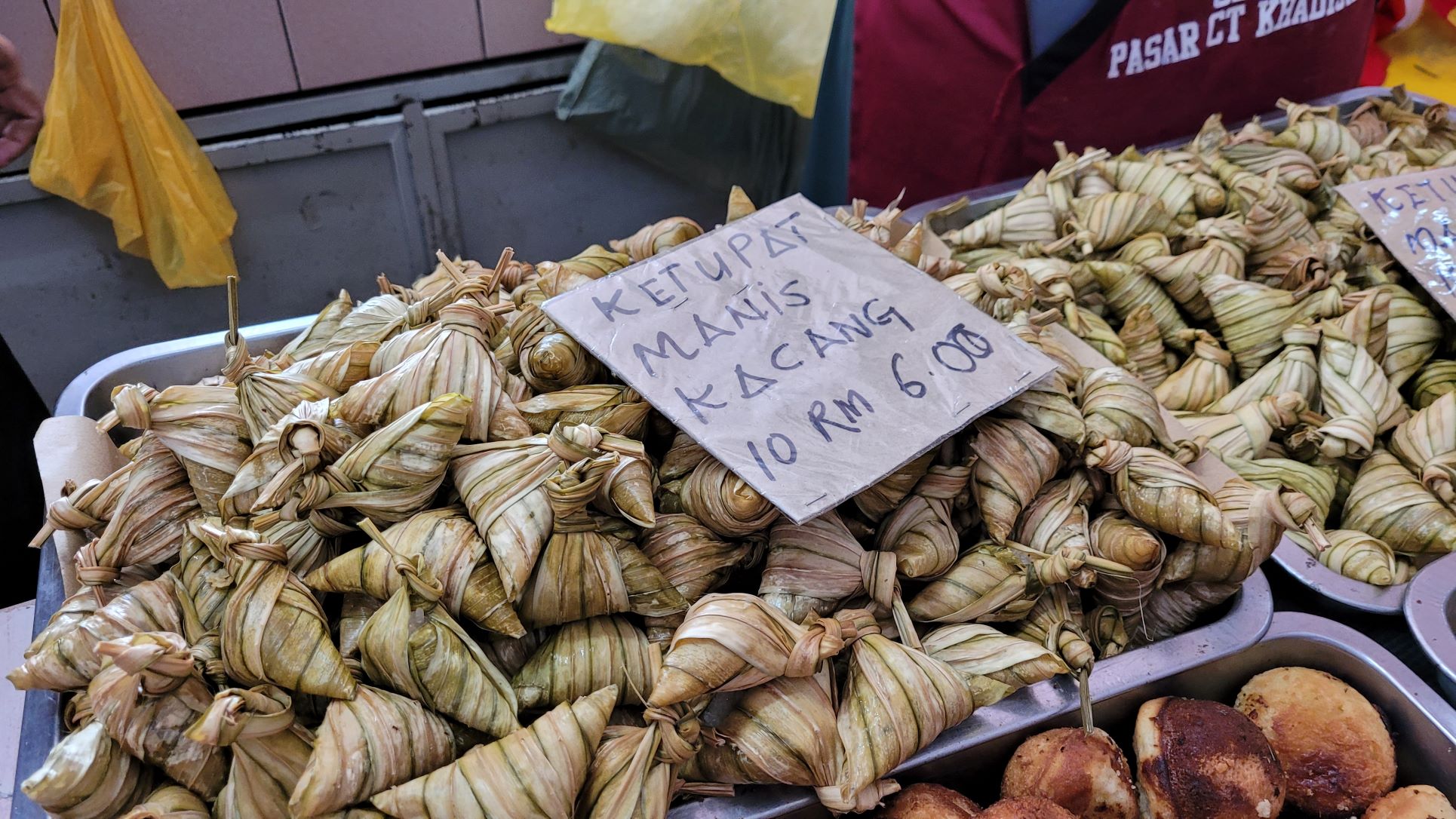
Ketupat serunding daging/kacang manis (Glutinous rice dumpling wrapped in a woven palm-leaf with either meat floss/sweet bean filling)


This reminded me of Kedah’s ketupat daun palas of which my mom used to do, the only different is that I have yet to see one with meat (chicken/beef) floss. I guess one can eat on the go lah kan, easy peasy.


Piyana Merbau (taste similar to bahulu)

One word = sedap gileeeeeeeeeeeer
A must must must try. Sampai termimpi-mimpi kay.


Acar Pisang Benggala


I tried to find out what is Pisang Benggala but fail so I am doing a direct translation – Bengal Banana (not sure of its origin though). The name of this dish is rather interesting as it is called acar meaning pickled but the dish looks like gulai or masak lemak ie banana cook in coconut milk gravy. Have you tried this? How does it taste like? Sourish? Spicy?


Ketupat Sotong (Squid stuffed with glutinous rice)

This is the most deceiving delicacy as it ketupat stuffed in squid, I would think it is a savoury dish but well well well…. What do you know, it is sweet. More like a dessert instead of a meal/dish. Masa first makan dulu, memang agak mengconfusekan.


Godok Telur

This kuih looks like apam crossed with kuih sarang burung. My only guess is that it is sweet and spongy in texture, I bet I’m gonna like it.

Looks like I need a repeat trip to Kelantan and sample all the food I missed (and repeat second round those that I like). What can I say, Kelantan is truly a food heaven.

So, sapa nak ikut I gi Kelantan!?!


The Ihya’ Ramadan Kelantan 2022 Media Fam Trip is organized by Tourism Malaysia Wilayah Timur in partnership with all its sponsors.


Related Posts Plugin for WordPress, Blogger...