Wednesday, August 23, 2017

Kimekomi Craft| Bringing Japan Home


I always say ‘In every country you visited, you’ll take a piece of it home’, and for Kak Latifah, Kimekomi craft has found a new home. Malaysia.


A foodie will hunt for good food, a photographer will scout for beautiful subject, a fashionista clothes, and an artisan or craftsman, art and craft (obviously). And this is the story of Kak Latifah Hamzah of Pulau Indah, the artisan behind easy-tuck craft or kimekomi, as what the Japanese calls them; the birth place of this few centuries old craft.

Traveling to Japan in 2015 was certainly a life changing mexperience for Kak Latifah, marveling at kimekomi craft during one of her many subway train ride, has sparked Kak Latifah’s interest and now has become her greatest passion. And what makes it even greater is the fact that she combines our very own Malaysia heritage; batik and songket into this old craft from Japan. The result – astounding.


I remembered telling Sham that when you have a good story behind a great product, it makes us; digital storyteller easy to write. Well, ‘easy’ is an understatement really, the right word should be eager, excited, enthusiastic or perhaps passionate as we felt the artisan love and sincerity in producing the craft, and the depth is rather contagious and overwhelming. Thus me writing this, enjoying and appreciating the artisan and their craft even more.

‘Wah’ and ‘Ooooh’ was the first (and only) thing you hear as we entered her studio, just like her subway experience, we too went googoo gaga over the art pieces. This is especially amplified when we laid our eyes on her ‘kebaya songket girls’ as well as her ‘owl family’ piece. Awestruck (I wasn’t even this awestruck when I saw Sheila Majid during her concert recently). First thing that came into my mind (and I verbalized it [after all, I can only contain so much]) was ‘Kak Latifah, berapa harga ni?’ / how much does this piece cost?, wanting to own it.


One must wonder, why the fuss over her art piece?
Here’s the thing, not only she combines our batik and songket into this centuries old craft, she formulates it in a way that it portrays our beautiful aMalaysia heritage and hculture; girls wearing traditional malay attire such as baju kurung pahang, kebaya, cekak musang and etc, easy-tucked it with songket fabric. If Kak Latifah marveled at what saw in Japan subway, we now are experiencing and doing the same. In a magnifying scale. And more.

She strongly believes that there are more than one way to promote our heritage and culture – batik and songket, by using kimekomi craft, she is able to combine both our fabric (heritage) and traditional attire (culture) into a beautiful art piece that can be easily sold, transport and showcased to public.


Knowing very well that she takes custom made orders, participate in exhibition and sells some of her work of art online, I ask her on her next step and as I suspected - ‘beginner classes’. So, you guys out there, go to the link below and follow Kak Latifah on her Facebook and wait for her announcement on craft classes.

What is Kimekomi craft?
"Kimekomi" means to "tuck in" in Japanese. Farbric is of Japanese design silk brocade tucked (and/or glued) into grooves that was carefully carved into.


This craft dated as far back as early 18th century. A priest at the Kamo Shrine in Kyoto named Tadashige Takahashi created a doll body from scraps of willow wood trees and covered it with left over fabrics used for the Shrine festivals, thus the name Kamo dolls. However, kimekomi doll is not temari ball craft as often confused.


For more info on Kak Latifah’s artwork : https://www.facebook.com/queenlscrafts/


Kembara Kraf Selangor 2017 Fam Trip is in collaboration with UPENS (Unit Perancangan Negeri Selangor) and all its sponsors with #GayaTravel as media coordinator.


Sunday, August 20, 2017

The True Meaning of Girl Power | Artsis Studio


This time around, Kembara Kraf Selangor 2017 brought a refreshing flavor, one that I initially thought was a great idea, later spellbounded by the sincerity, intention (niat) and generosity that I definitely knew there’s hope in our community, humanity and country. (Yeah I know! Sounded a little dramatic but in all honesty, this is how I really felt). And this is how my self-reflection journey started…


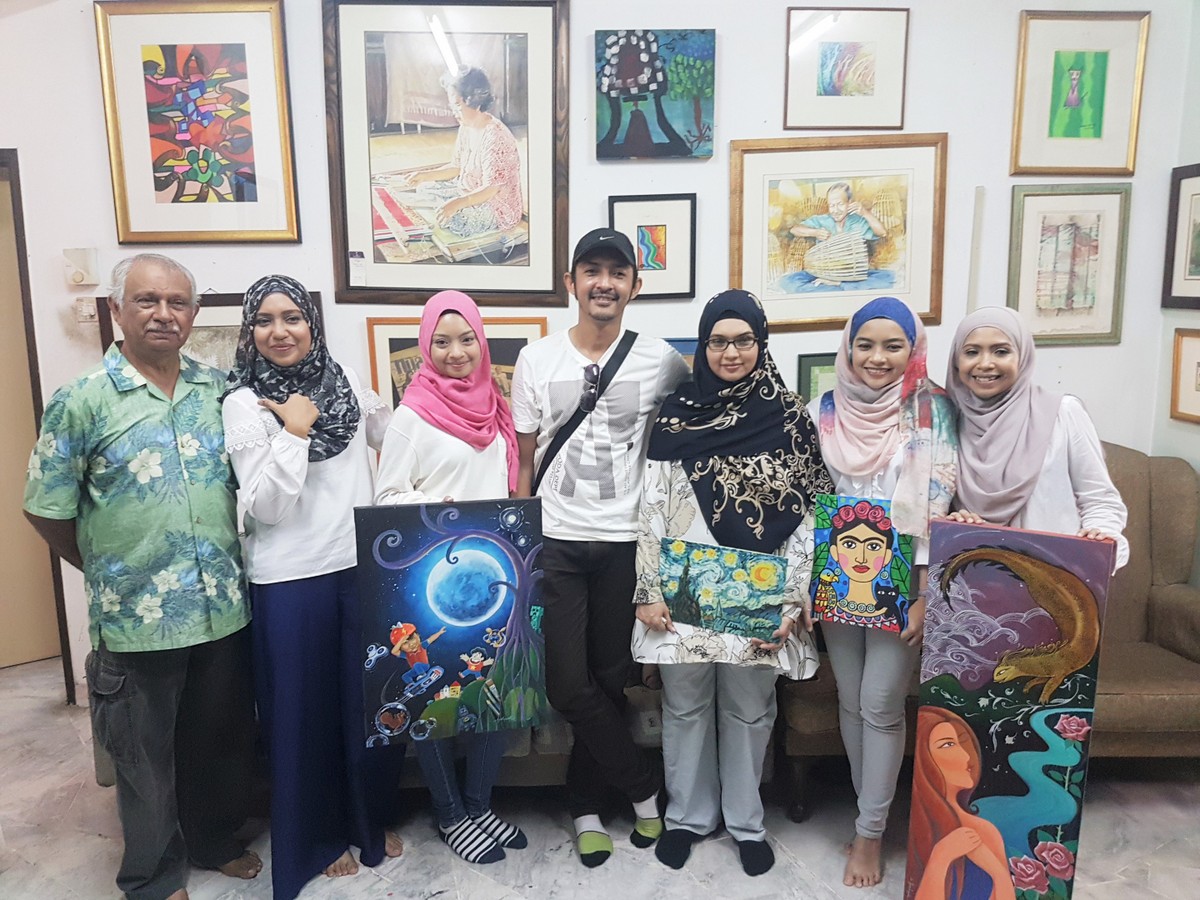
A family that creates Art together, stays together.


That was how Uncle started his conversation, believing that art keeps his family united. He even jokingly told us that his love for art was not materialize during his younger days hence him imposing it onto his children, of which, it really paid off. Alhamdulillah. I doubt there’s any regret among them, in fact, I think they rather enjoy it (and appreciate it of cause). Fast forward years later, they are now a known artist in their own right; a career woman that combines passion and academic – successful marketers, graphic designer, PR specialist and town planner. And as if what they’ve achieved is not (good) enough, they decided to give back to the community by starting an art class for kids in the neighbor, hopefully expending to adult art class (of which I plan to enroll *wink*).


Having honored by The Malaysia Guinness Books of Records for having the most artist in a family created the curiosity in me, reason being their abah, fondly called by the children; Dato’ Haji Mohd Yusoff Jaafar was the former Commissioner of Police, Sarawak. Police force; a person whom many would presumably felt strict, fierce and boring. And Oh Boy! Was I wrong, he was everything but. He not only instilled the love for art into his kids at young age, he cultivated their talent, nurtured their genre and supported their interest. Unsurprisingly, some of his kids not only have painting as talent, they are also actively involved in music – also a form of art. This can be seen is some of their artwork.


Like a little Cheshire cat, I asked further, the genre of each of the sibling’s artwork, and the same time learning the name of the genre. Killing 2 birds with 1 stone I call it *grin*. I soon learn those painting with human element where in photography is called portraiture is called figurative in painting (correct me if I am wrong here), noticed that some of the sign-off is by Yati; the eldest sister. Then there’s Van Gogh style, one that looks like Starry Starry Night; not quite sure which sister mastered this genre, then there’s also naïve art of which I kinda like it. But one that captivated me the most is the sister (forgotten her name, silly me) that dotted on her paintings, claiming that she doesn’t fancy ‘a flat/solid surface’ and I told her that the first thing came to my mine is Australia aborigine art. I bet she’ll be famous if she exhibits her work of art there. You go girl!


My curiosity need to be fed, I enquired on the format of the art classes for kids. Guiding and nurturing kids’ talent is what we ‘all expected, but as usual, the family when over and beyond to teach these kids, they taught them to see beyond the bubble’, as it is not colourless, it came in many sizes and that it glitters. Grasp that and translate it onto the drawing board. Aside from that, the classes also share the background of the artist itself, the genre and history behind it. This way, the understanding and appreciation of art is more robust, more depth and full of soul, not a mere 2Ds; on a piece of paper.

After asking my usual ‘Why, When, Who and What’, I came to realized that I actually ran out of questions (which is kinda rare for me, those whom know me well will vouch for this).


‘Teruja’ and ‘terkesima’ is an understatement when you meet them Art Sis; a true to life Girl Power.


So, step aside Power Puff Girls, bow to them queens! *flip tudung*


Artsis Studio
Email : artsisstudio@gmail.com
FB Page : Artsis Studio
Instagram : @artsisstudi
Mobile : +6018-327 0902
Town : USJ 9, UEP Subang Jaya


Kembara Kraf Selangor 2017 Fam Trip is in collaboration with UPENS (Unit Perancangan Negeri Selangor) and all its sponsors with #GayaTravel as media coordinator.


Wednesday, July 5, 2017

Sarawak Cultural Village : An Open Air Living Musuem


Land of The Hornbills.
Where Adventure Lives.
More Than Paradise.


These are names given to Sarawak. All of which I wholeheartedly agree.
I always believe that the cultural village of any country is good; it is impossible for us to venture throughout every single country and learn their history, culture and customs.

After visiting plenty cultural villages - both local and abroad - I realized that our very own cultural villages is at par with those I’ve seen. And I am truly impressed and in love with Sarawak Cultural Village (SCV), located at the foot of Gunung Santubung. Rich in history, culture and heritage, rewarded with beautiful natural wonders, blessed with charming heartfelt warmness, Sarawak boasts a complete package that every traveller can only call paradise.

Sarawak Cultural Village is an open air living museum portraying the cultural and heritage of Sarawak’s main ethnicities, showcasing handicrafts, food, weapon, fashion as well as dances. The houses that one can experience here are the Orang Ulu Longhouse, the Melanau Tall House, the Bidayuh Longhouse, the Iban Longhouse, the Malay Kampung House and the Chinese Farm House. Every house has its unique characteristic and ethnic showcase, hence no two houses are the same hence I advise that you allocate few hours if you plan to visit this enchanting place. Another thing you should check out is the local food being served at the cafeteria, from ayam pansuh to umai to uban goreng belacan; the food here will surely excite your palate. 


My first experience of the Sarawak Cultural Village was awe-inspiring. The first thing that came to mind was the museum I visited in Romania. I tend to travel with minimal planning, letting my feet carve my path. That's what happened in Romania, taking me to a living museum. And since then, my benchmark for cultural villages is Dimitrie Gusti National Village Museum in Bucharest, Romania. The one in Stockholm couldn't really compete. These are my thoughts on a living museum of which Sarawak Cultural Village met the mark.
  • The SCV team were friendly & knowledgeable, which is key as visitors will have a lot of questions to ask and they have to be fed with accurate information.
  • The longhouses and tall houses in SVC were modeled as close to an original authentic home, as how it should be; the closest best.
  • Having the locals to represent their ethnic homes, heritage and culture nailed it.
  • SCV keeping it to 5 main ethnicity was a good move : Iban, Bidayuh, Ulu, Melanau, Penan, as well as Malay and Chinese home.


Bidayuh Longhouse
SCV educates visitors on Bidayuh's custom & culture. 


Iban Longhouse
The art of weaving beads that enthrall us.


Penan Hut
SCV taught us on Sarawak's jungle nomad: Orang Penan.


Orang Ulu Longhouse
We learnt from SCV on Orang Ulu's sword craftsmanship.


Melanau Tall House
It's Melanau Tall House not longhouse, we found out at SCV.


Malay Kampung House
It portrays the simplicity of Malay kampung house with local delicacies.


Chinese Farm House
It is a farmer’s house with the usual oriental décor and the only home here that is floored by the earth.


And at Sarawak Cultural Village (SCV), your visit will end with performance which will blow your mind away. The SCV mini concert should not be missed!

So, my verdict on #Sarawak Cultural Village?


... A must-mandatory-compulsory place to go if you are in Kuching.


Entrance Fee
RM 60.00 (US$20.00) - Adult
RM 30.00 (US$10.00) - Child : 6-12 years old
Free for Children aged under 6 years old

Sarawak Cultural Village
Pantai Damai, Santubong
Kuching, Sarawak
Email: enquiry@scv.com.my

Website: http://www.scv.com.my/


Related Posts Plugin for WordPress, Blogger...